
The Serengeti Great Migration is not a single river crossing or one dramatic week in the year. It is a continuous, year-round wildlife cycle across the greater Serengeti–Mara ecosystem, shaped by rainfall, fresh grazing, calving, rutting, predator pressure, river systems and seasonal movement between Tanzania’s Serengeti National Park and Kenya’s Maasai Mara.
UNESCO describes Serengeti National Park as 1.5 million hectares of savannah where vast herds of wildebeest, gazelles and zebras migrate toward water and grazing while predators follow them; it also identifies the migration as one of the world’s most impressive natural events.
Quick Answer: What Is the Serengeti Great Migration?
The Great Migration in the Serengeti is the annual movement of wildebeest, zebras and gazelles through the Serengeti ecosystem in search of fresh grass and water. The cycle usually includes calving in the southern plains, northwest movement through central and western Serengeti, Grumeti River crossings, Mara River crossings in the north, and a return south when rains regenerate grazing.
The exact route changes each year. Herds respond to rainfall, pasture quality, water availability and local conditions, so no operator should promise exact locations on a fixed date.
Serengeti Migration at a Glance
| Migration Question | Practical Answer |
|---|---|
| Best overall time to see the migration | December–March for calving; June–July for western movement and Grumeti; July–October for northern Serengeti and Mara River crossings |
| Best area for calving | Southern Serengeti, Ndutu and the short-grass plains |
| Best area for river crossings | Northern Serengeti around Kogatende, Lamai and the Mara River |
| Best area in June | Western Corridor and Grumeti region, depending on rainfall |
| Is the migration guaranteed? | No. The migration is a natural movement pattern, not a scheduled event |
| Can you see migration in the rainy season? | Yes. The green season is especially important for calving and southern plains movement |
| Serengeti vs Maasai Mara | Serengeti has the longer migration cycle; Maasai Mara is mainly a dry-season northern extension of the same ecosystem |
How the Serengeti Migration Works
The migration is driven by a simple ecological need: the herds follow fresh grazing and water. The Serengeti’s rainfall pattern creates waves of new grass across different regions at different times of the year.
In broad terms:
- Short rains refresh the southern plains from around November and December.
- Herds gather in the southern Serengeti and Ndutu for grazing and calving.
- As the plains dry, the herds move northwest and west.
- Some herds pass through the central Serengeti and Western Corridor.
- The strongest dry-season movement pushes toward northern Serengeti and the Mara River.
- When southern rains return, many herds begin moving back south.
UNESCO notes that the Serengeti migration is a circular annual trek across Kenya and Tanzania involving over one million wildebeest plus hundreds of thousands of other ungulates, and that the park supports one of the world’s major predator–prey systems.
Serengeti Migration Map: The Main Movement Route
A Serengeti migration map should be understood as a seasonal movement pattern, not a fixed road map. Herds may split, pause, double back or spread over large areas.
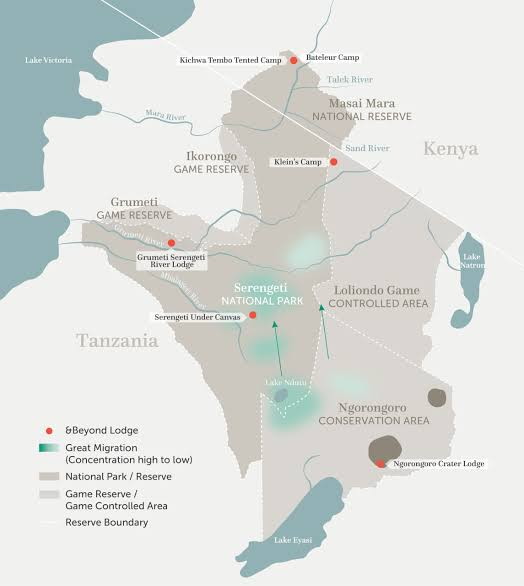
Typical Migration Route
| Stage | Broad Area | What Happens |
|---|---|---|
| December–March | Southern Serengeti, Ndutu, short-grass plains | Calving, predator activity, green-season grazing |
| April–May | Southern to central and western Serengeti | Herds begin moving as plains dry |
| June–July | Western Corridor, Grumeti, central-west routes | Rutting period and possible Grumeti River crossings |
| July–October | Northern Serengeti, Kogatende, Lamai, Mara River | Dry-season movement and possible Mara River crossings |
| October–November | Northern, eastern and central return routes | Herds begin responding to short rains |
| November–December | Central, eastern and southern Serengeti | Movement back toward the southern plains |
Important Planning Note
A good migration safari does not rely on one pin on a map. It is planned around the right region for the season, with enough safari days to adjust based on local reports.
Serengeti Migration Calendar by Month
For deeper planning, use the full month-by-month guides:
- Serengeti Migration Calendar
- Serengeti Migration in January
- Serengeti Migration in February
- Serengeti Migration in March
- Serengeti Migration in April
- Serengeti Migration in May
- Serengeti Migration in June
- Serengeti Migration in July
- Serengeti Migration in August
- Serengeti Migration in September
- Serengeti Migration in October
- Serengeti Migration in November
- Serengeti Migration in December
Month-by-Month Serengeti Migration Summary
| Month | Best Migration Area | What Visitors May See |
|---|---|---|
| January | Southern Serengeti, Ndutu | Herds gathering on green plains; early calving may begin |
| February | Ndutu and southern short-grass plains | Peak calving, predators, newborn wildebeest |
| March | Southern Serengeti and Ndutu | Calving continues; herds spread with rainfall |
| April | Southern to central Serengeti | Rainy-season movement, fewer crowds, lush scenery |
| May | Central and western movement routes | Herds begin pushing northwest; dramatic clouds and green plains |
| June | Western Corridor, Grumeti, central-west | Rutting season, long columns of wildebeest, possible Grumeti crossings |
| July | Western/northern transition, Kogatende | Herds moving north; early Mara River crossing possibilities |
| August | Northern Serengeti, Mara River | Prime northern migration season and possible river crossings |
| September | Northern Serengeti, Lamai, Kogatende | Strong crossing potential; herds may move between Tanzania and Kenya |
| October | Northern and eastern Serengeti | Late crossings possible; dry-season wildlife concentration |
| November | Central, eastern and southern return routes | Short rains may pull herds south again |
| December | Southern Serengeti and Ndutu | Herds return to green plains; calving season approaches |
Asilia’s migration guidance also emphasizes that calving is commonly associated with the southern Serengeti from late December to mid-March, while Mara River crossing planning is often focused around late July to early September, though timing varies by year.
Best Time to See the Serengeti Migration
The best time depends on the migration experience you want.
Best for Calving: January to March
Choose January, February or March if you want:
- Newborn wildebeest calves
- Large herds on open plains
- Predator activity involving lions, hyenas, cheetahs and jackals
- Green landscapes and dramatic skies
- Strong access to Ndutu and southern Serengeti
The best-known calving window is usually February, but the exact timing depends on rainfall and grass conditions.
Best for Rutting and Movement: May to June
Choose May or June if you want:
- Long moving columns of wildebeest
- Male competition during rutting season
- Fewer crowds than peak river-crossing months
- Western and central Serengeti safari routes
- Good value compared with the busiest peak months
Best for River Crossings: July to October
Choose July, August, September or October if you want:
- Northern Serengeti migration safaris
- Mara River crossing possibilities
- Kogatende and Lamai access
- Dry-season wildlife concentrations
- Dramatic predator and crocodile encounters around rivers
River crossings are never guaranteed. Herds may wait for hours, turn back, cross out of sight, cross at a different point or move at night.
Where Is the Serengeti Migration Now?
The honest answer is: it depends on current rainfall and field reports.
A reliable “where is the migration now?” page should not claim exact herd coordinates. Instead, it should give:
- The most likely current migration region
- Recent rainfall influence
- General herd direction
- Best nearby airstrips
- Recommended safari bases
- Whether current conditions favor calving, movement, river crossings or dispersed grazing
Use this supporting page for updates:
Where Is the Serengeti Migration Now?
What a Live Migration Update Should Say
A useful update should sound like this:
“Herds are currently being reported across the broader Ndutu and southern Serengeti plains, with movement influenced by recent rainfall. Visitors should plan around the southern plains rather than expecting one exact viewing point.”
Avoid claims like:
“The herds will be at Crossing Point 7 on 18 August.”
That is not how the migration works.
Best Serengeti Areas for Migration
Southern Serengeti and Ndutu
Best for:
- Calving season
- Green-season migration
- Big open plains
- Predator activity
- Photography of newborn calves
Main months:
- December
- January
- February
- March
Useful supporting pages:
Central Serengeti and Seronera
Best for:
- Year-round resident wildlife
- Migration transition routes
- Flexible itineraries
- First-time Serengeti visitors
- Combining different regions
Main months:
- April
- May
- November
- December
Central Serengeti is not always the densest migration area, but it is one of the best logistical bases because it connects southern, western, eastern and northern routes.
Western Corridor and Grumeti
Best for:
- June movement
- Rutting season
- Western Serengeti scenery
- Possible Grumeti River crossings
- Fewer crowds than Mara River crossing zones
Main months:
- May
- June
- July
Useful supporting page:
Northern Serengeti, Kogatende and Lamai
Best for:
- Mara River crossings
- Dry-season migration
- Remote northern landscapes
- Cross-border movement with Maasai Mara
- Longer stays focused on river activity
Main months:
- July
- August
- September
- October
Useful supporting pages:
Serengeti River Crossings
River crossings are the most famous part of the migration, but they are also the most misunderstood. A crossing is not a scheduled show. It happens when herd pressure, river conditions, bank access and animal momentum align.
Mara River Crossings
The Mara River crossings are the dramatic crossings most travelers imagine: steep banks, fast-moving water, crocodiles and large herds hesitating before crossing.
Best area:
- Northern Serengeti
- Kogatende
- Lamai
- Mara River crossing zones
Typical planning season:
- July to October, with August and September often the most requested months
Supporting page:
Mara River Crossings Serengeti
Grumeti River Crossings
The Grumeti River crossings happen farther west and are usually associated with the herds moving through the Western Corridor. They are different from Mara River crossings: often less crowded, more dependent on water levels and usually part of a broader western Serengeti safari.
Best area:
- Western Corridor
- Grumeti area
- Central-west routes
Typical planning season:
- May to July, especially June in many years
Supporting page:
Wildebeest Calving Season in Serengeti
The wildebeest calving season is one of the most important events in the migration cycle. It usually takes place on the southern Serengeti and Ndutu plains when fresh grass provides nutrition for pregnant females and newborn calves.
Why Calving Happens in the South
The short-grass plains of southern Serengeti and the Ndutu area provide:
- Fresh green grazing after seasonal rains
- Open visibility for detecting predators
- Mineral-rich grasses
- Space for huge herds to spread out
- Access to the wider Ngorongoro–Serengeti ecosystem
What Visitors May See
During calving season, visitors may see:
- Newborn wildebeest standing within minutes
- Large nursery herds
- Zebras mixed among wildebeest
- Lions and hyenas watching the herds
- Cheetahs hunting on open plains
- Vultures and jackals around predator kills
Best supporting pages:
Wildebeest Rutting Season
The wildebeest rutting season is the mating period of the migration. It usually takes place as herds are moving through central and western parts of the ecosystem, often around May and June.
What Makes the Rutting Season Special
Visitors may see:
- Male wildebeest defending temporary territories
- Snorting, chasing and parallel running
- Large herds moving in long lines
- Predator activity around tired or distracted animals
- Excellent photographic opportunities without peak crossing crowds
Supporting page:
Serengeti Wildebeest Rutting Season
Serengeti Migration Safari Planning
A good Serengeti migration safari is built around the season, not around a generic itinerary.
How Many Days Do You Need?
| Safari Length | Best For |
|---|---|
| 3–4 days | Quick Serengeti visit, best if flying directly into the right region |
| 5–6 days | Better chance of matching the right area and enjoying resident wildlife |
| 7–9 days | Strong migration-focused safari with flexibility |
| 10+ days | Combining calving, central Serengeti, northern Serengeti or Ngorongoro |
For river crossings, more days improve your chances because herds may gather near the river without crossing immediately.
Sample Serengeti Migration Safari Itineraries
5-Day Calving Season Safari
Best months:
- January
- February
- March
Suggested route:
- Arusha to Ndutu or southern Serengeti
- Full day in Ndutu plains
- Full day southern Serengeti / short-grass plains
- Optional central Serengeti extension
- Return to Arusha or fly out
Best for:
- Calving
- Big herds
- Predator action
- Green-season photography
6-Day Western Corridor and Grumeti Safari
Best months:
- May
- June
- early July
Suggested route:
- Arusha to central Serengeti
- Central Serengeti migration search
- Western Corridor
- Grumeti area
- Central or western Serengeti
- Fly or drive out
Best for:
- Rutting season
- Moving columns
- Grumeti River possibilities
- Fewer crowds
7-Day Northern Serengeti Migration Safari
Best months:
- July
- August
- September
- October
Suggested route:
- Arusha to central or northern Serengeti
- Transfer/game drive to Kogatende
- Full day Mara River area
- Full day northern Serengeti
- Full day Lamai/Kogatende region
- Optional central Serengeti
- Fly out or continue to Ngorongoro
Best for:
- Mara River crossing attempts
- Northern Serengeti landscapes
- Dry-season wildlife
- Longer migration-focused game drives
Supporting page:
Northern Serengeti Migration Safari
Migration Camps in Serengeti
Migration camps are safari camps positioned for seasonal wildlife movement. They may be permanent, seasonal or mobile.
Permanent Camps
Best for:
- Comfort
- Strong infrastructure
- Reliable services
- Easier logistics
- Travelers who want a lodge-style safari
Permanent camps work well in central Serengeti, northern Serengeti and some western areas.
Seasonal Camps
Best for:
- Being closer to the migration seasonally
- Stronger wildlife positioning
- More immersive bush experience
- Avoiding long daily drives from the wrong base
Seasonal camps often operate in Ndutu during calving season and northern Serengeti during crossing season.
Mobile Camps
Best for:
- Migration-focused travelers
- Serious photographers
- Returning safari guests
- Guests who want proximity over luxury facilities
Mobile camps move seasonally to follow broad migration patterns, but even mobile camps cannot guarantee exact herd locations every day.
Migration Safari Costs
Serengeti migration safari costs depend on season, routing, accommodation level, transport method and whether you use private or shared safari arrangements.
Main Cost Drivers
| Cost Factor | Why It Matters |
|---|---|
| Travel month | July–September and calving season can be more expensive |
| Safari area | Northern Serengeti often costs more because of distance and fly-in logistics |
| Accommodation type | Mobile camps, luxury camps and prime-location lodges vary widely |
| Private vs shared vehicle | Private safaris cost more but offer flexibility |
| Flying vs driving | Fly-in safaris save time but increase cost |
| Number of nights | Migration safaris work best with enough time in the right area |
| Park and concession fees | These can form a significant part of the total cost |
How to Control Costs
To reduce migration safari costs:
- Travel in shoulder months such as March, April, May, June or November.
- Use central Serengeti as a flexible base when appropriate.
- Combine road transfers with selected internal flights.
- Choose mid-range seasonal camps instead of top-end luxury camps.
- Stay longer in fewer areas instead of moving every night.
Is the Serengeti Migration Guaranteed?
No. The migration is not guaranteed in the sense of exact sightings on exact dates.
What can be planned:
- The best region for each season
- The right safari duration
- The most suitable camp location
- A flexible route
- Access to local guide and camp reports
What cannot be guaranteed:
- Exact herd position
- River crossing timing
- Predator hunts
- Calving on a specific day
- Weather and road conditions
- Whether herds will cross while you are present
A responsible migration safari should promise good planning, not a guaranteed crossing.
Can Visitors See the Migration in the Rainy Season?
Yes. The rainy season can be excellent for the migration, especially in the southern Serengeti.
Why the Rainy Season Matters
Rain brings:
- Fresh grass
- Calving conditions
- Greener landscapes
- Lower dust
- Dramatic skies
- Fewer vehicles in some areas
Rainy-Season Trade-Offs
Visitors should also expect:
- Possible muddy roads
- Some longer drives
- More dispersed herds
- Rain showers, often in bursts
- Seasonal camp access considerations
For travelers who want calving, newborns and predators, the rainy or green season can be one of the best times to visit.
Serengeti Migration vs Maasai Mara Migration
The Serengeti migration and Maasai Mara migration are part of the same larger ecosystem, but they are not the same safari experience.
| Comparison | Serengeti Migration | Maasai Mara Migration |
|---|---|---|
| Country | Tanzania | Kenya |
| Role in cycle | Larger year-round migration landscape | Northern dry-season extension |
| Best-known event | Calving, Grumeti, Mara River crossings, full annual cycle | Mara River crossings and dry-season herds |
| Best months | Year-round depending on region | Usually July–October |
| Space and scale | Vast, with multiple regions | Smaller reserve, high wildlife density |
| Planning style | Choose region by month | Focus on Mara season and crossing areas |
Supporting page:
Serengeti Migration vs Maasai Mara Migration
Best Serengeti Migration Safari by Travel Goal
| Travel Goal | Best Months | Best Area |
|---|---|---|
| See newborn calves | January–March | Ndutu, southern Serengeti |
| See predator action | February–March, July–October | Southern plains or northern river zones |
| Avoid peak crowds | April–June, November | Central, western or southern routes |
| See river crossings | July–October | Northern Serengeti, Mara River |
| See rutting behavior | May–June | Central-west and Western Corridor |
| Best photography | February, March, August, September | Southern plains or northern Serengeti |
| Best value | April, May, November | Central/southern/western depending on rainfall |
Common Mistakes When Planning a Migration Safari
Mistake 1: Thinking the Migration Only Happens at the Mara River
River crossings are famous, but the migration also includes calving, rutting, predator interactions, grazing movement and return routes.
Mistake 2: Booking the Wrong Region for the Month
A camp can be excellent but still be far from the main migration movement during your travel dates.
Mistake 3: Staying Too Few Nights for River Crossings
For crossings, one night is risky. Herds may wait, scatter or cross elsewhere.
Mistake 4: Expecting Exact Herd Locations
The migration is dynamic. Broad seasonal positioning is reliable; exact daily prediction is not.
Mistake 5: Ignoring Resident Wildlife
Even when migration herds are moving elsewhere, Serengeti has excellent resident wildlife, especially in central and northern regions.
Internal Guide Library: Serengeti Great Migration Silo
Core Migration Pages
- Serengeti Migration Calendar
- Where Is the Serengeti Migration Now?
- Serengeti Migration vs Maasai Mara Migration
Month-by-Month Pages
- January Migration
- February Migration
- March Migration
- April Migration
- May Migration
- June Migration
- July Migration
- August Migration
Seasonal Event Pages
- Serengeti Wildebeest Calving Season
- Southern Serengeti Calving Season
- Serengeti Wildebeest Rutting Season
- Mara River Crossings Serengeti
- Grumeti River Crossings
- Northern Serengeti Migration Safari
Frequently Asked Questions
What is the best month to see the Serengeti migration?
There is no single best month for everyone. February is best for calving in the southern Serengeti, while August and September are among the most popular months for northern Serengeti and Mara River crossing safaris.
Where is the Great Migration in Serengeti?
The migration moves through different Serengeti regions during the year. It is commonly in the southern plains from December to March, central and western routes from April to June, and northern Serengeti from July to October.
Are Mara River crossings guaranteed?
No. Mara River crossings are natural events. Herds may gather near the river but cross later, cross elsewhere, turn back or move at night.
Is the Serengeti better than Maasai Mara for migration?
For the full annual migration cycle, Serengeti is better because it includes calving, rutting, Grumeti movement, Mara River crossings and return routes. Maasai Mara is excellent for the northern dry-season phase, especially from around July to October.
Can I see the migration in April or May?
Yes, but the herds may be more spread out because of rains and fresh grazing. April and May can offer lush landscapes, fewer vehicles and lower-season value.
What is the best area for a first Serengeti migration safari?
For calving, choose Ndutu or southern Serengeti. For river crossings, choose northern Serengeti. For flexibility, central Serengeti can work well as part of a broader route.
How many days should I spend on a migration safari?
Plan at least 5 to 7 days if the migration is your main goal. For river crossings, more days in northern Serengeti give you a better chance of being in the area when herds decide to cross.
Final Planning Advice
The Serengeti Great Migration is best understood as a living seasonal cycle, not a one-day event. The right safari depends on matching your travel month to the right Serengeti region: southern plains for calving, western and central routes for movement and rutting, and northern Serengeti for Mara River crossing possibilities.
The best migration safari plans with nature rather than against it: choose the right season, stay in the right area, allow enough time, and avoid any itinerary that promises exact herd locations.